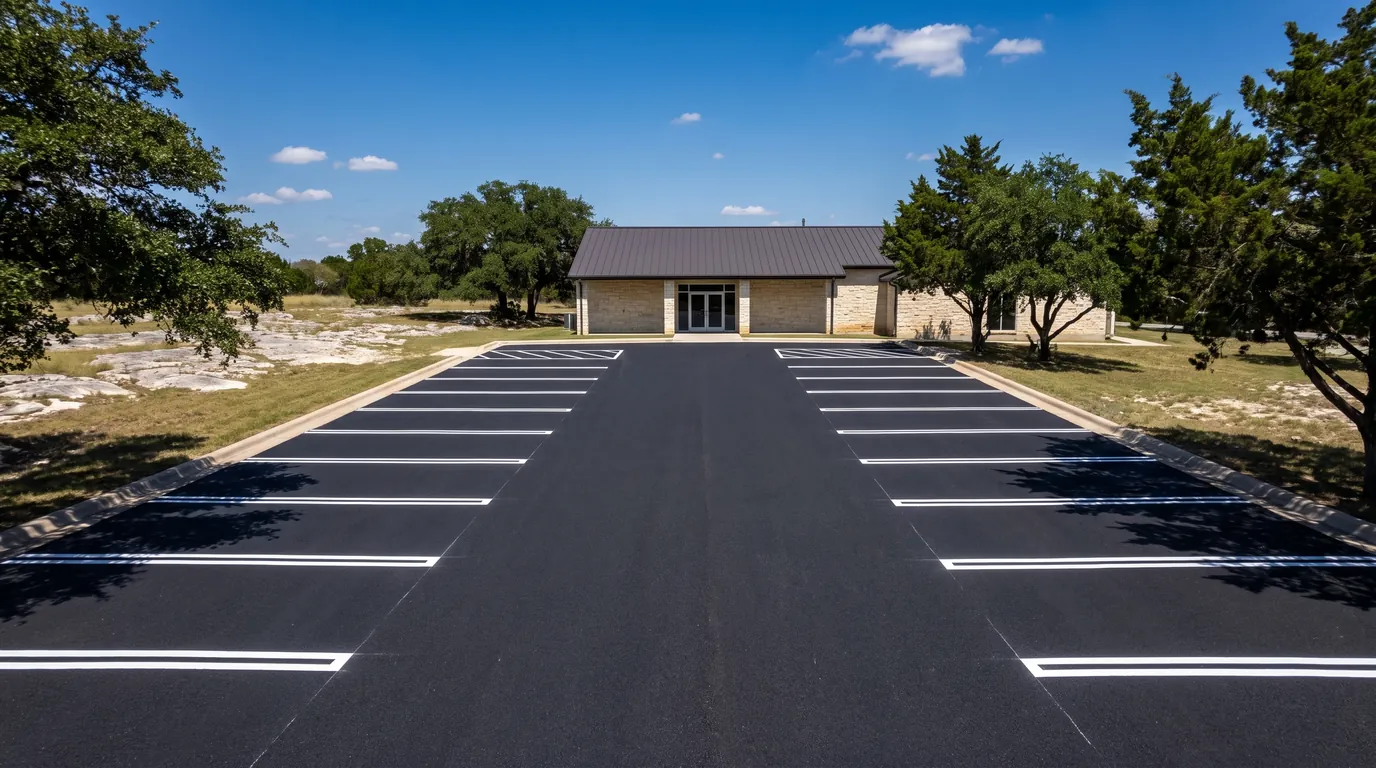
National Asphalt Paving stripes lots around Austin, and we check the accessible spaces in every lot we stripe against these rules. The rules come from the 2010 ADA Standards for Accessible Design, the Texas Accessibility Standards and the Texas Department of Licensing and Regulation’s (TDLR) rules, and the Texas Transportation Code, cited by section. This is a plain summary for planning, not legal advice, and for a specific site, TDLR and a Registered Accessibility Specialist have the final word.
How many accessible spaces a lot needs
Under §208.2 of the 2010 ADA Standards, the minimum number of accessible spaces depends on the total number of spaces in each parking facility. A facility with 1 to 25 spaces needs 1 accessible space, one with 26 to 50 needs 2, one with 401 to 500 needs 9, and one with 501 to 1,000 needs 2 percent of the total. When a site has more than one parking facility, the count is figured for each facility. Hospital outpatient facilities, rehabilitation and outpatient physical therapy facilities, and residential facilities have their own requirements under §§208.2.1 to 208.2.3.
Under §208.2.4 of the 2010 ADA Standards, at least one of every six accessible spaces, or fraction of six, must be a van space. Section 208.3.1 requires accessible spaces serving a building to be on the shortest accessible route to an accessible entrance.
| Total spaces in the parking facility | Minimum accessible spaces |
|---|---|
| 1 to 25 | 1 |
| 26 to 50 | 2 |
| 51 to 75 | 3 |
| 76 to 100 | 4 |
| 101 to 150 | 5 |
| 151 to 200 | 6 |
| 201 to 300 | 7 |
| 301 to 400 | 8 |
| 401 to 500 | 9 |
| 501 to 1,000 | 2 percent of the total |
| 1,001 and over | 20, plus 1 for each 100 (or fraction) over 1,000 |
Source: 2010 ADA Standards, Table 208.2.
Space and access aisle sizes
Under §502.2 of the ADA Standards, car spaces must be at least 96 inches wide, while van spaces must be at least 132 inches wide or 96 inches wide when the van space’s access aisle is at least 96 inches wide. Section 502.1 measures those widths from the centerline of the painted lines. Under §502.3, every accessible space needs an adjacent access aisle at least 60 inches wide that runs the full length of the space, and two spaces can share one aisle. That section also requires aisles to be marked to discourage parking in them and prohibits them from overlapping the drive lane.
Section 502.4 requires spaces and aisles to be level with each other, with slopes no steeper than 1:48 (about 2 percent). Under §502.5, van spaces and the routes to them need 98 inches of vertical clearance, which matters in parking garages. The Standards don’t set a marking method or color, and the advisory to §502.3.3 leaves those choices to state or local rules.
Signs
Under §502.6 of the ADA Standards, each accessible space needs a sign with the International Symbol of Accessibility, with the words “van accessible” added for van spaces. The bottom of the sign must sit at least 60 inches above the ground. Section 216.5 of the ADA Standards says a site with four or fewer parking spaces in total doesn’t need identification signs. Texas adds its own sign rule.
Texas rules on top of the ADA
The Texas Accessibility Standards (TAS), adopted in 2012 and run by the Texas Department of Licensing and Regulation (TDLR), use the same parking text as the 2010 ADA Standards. Texas adds a separate rule in 16 Texas Administrative Code §68.104, in effect since August 1, 2020. A paved accessible space needs the International Symbol of Accessibility painted on its surface in a color that contrasts with the pavement. Each adjacent access aisle needs “NO PARKING” painted in capital letters at least 12 inches tall with a 2-inch stroke. A sign stating at least “Violators Subject to Fine and Towing” in letters at least 1 inch tall must be mounted no more than 8 inches below the accessibility sign, with its bottom edge 48 to 80 inches above the ground.
Texas Government Code §469.101 and 16 TAC §68.21 require a project covered by the Architectural Barriers Act with an estimated construction cost of $50,000 or more to be registered with TDLR. Texas Government Code §469.105 requires an inspection within a year of completion. TDLR’s FAQ says a project under $50,000 doesn’t have to be registered but still has to comply with TAS. Privately funded public accommodations and commercial facilities are covered under Texas Government Code §469.003.
Under Texas Transportation Code §681.011, blocking an access aisle or curb ramp with a vehicle is an offense. The fine is $500 to $750.
Restriping an existing lot
The U.S. Justice Department’s “ADA Compliance Brief: Restriping Parking Spaces” (last updated February 28, 2020) says a business or a state or local government that restripes a lot must provide accessible spaces as required by the 2010 ADA Standards. The brief calls restriping “readily achievable in most cases” because it’s relatively inexpensive. It says to put added spaces on the most level ground close to the accessible entrance, with an accessible route between them.
Both the 2010 ADA Standards and the Texas Accessibility Standards (TAS) count resurfacing of vehicular ways as an alteration under §106.5. Before we restripe a lot, we count its spaces against the table and check the accessible spaces, aisles, and signs against these rules as part of our parking lot striping work.
Sources
- U.S. Department of Justice: 2010 ADA Standards for Accessible Design (§§106.5, 208, 216.5, 502)
- U.S. Department of Justice: ADA Compliance Brief, Restriping Parking Spaces (updated February 28, 2020)
- TDLR: 2012 Texas Accessibility Standards
- 16 Texas Administrative Code §68.104, Accessible Parking Spaces
- 16 Texas Administrative Code §68.21, Registration of Project or Lease Required
- Texas Government Code chapter 469 (§§469.003, 469.101, 469.105)
- TDLR: Architectural Barriers FAQ
- Texas Transportation Code chapter 681 (§681.011)