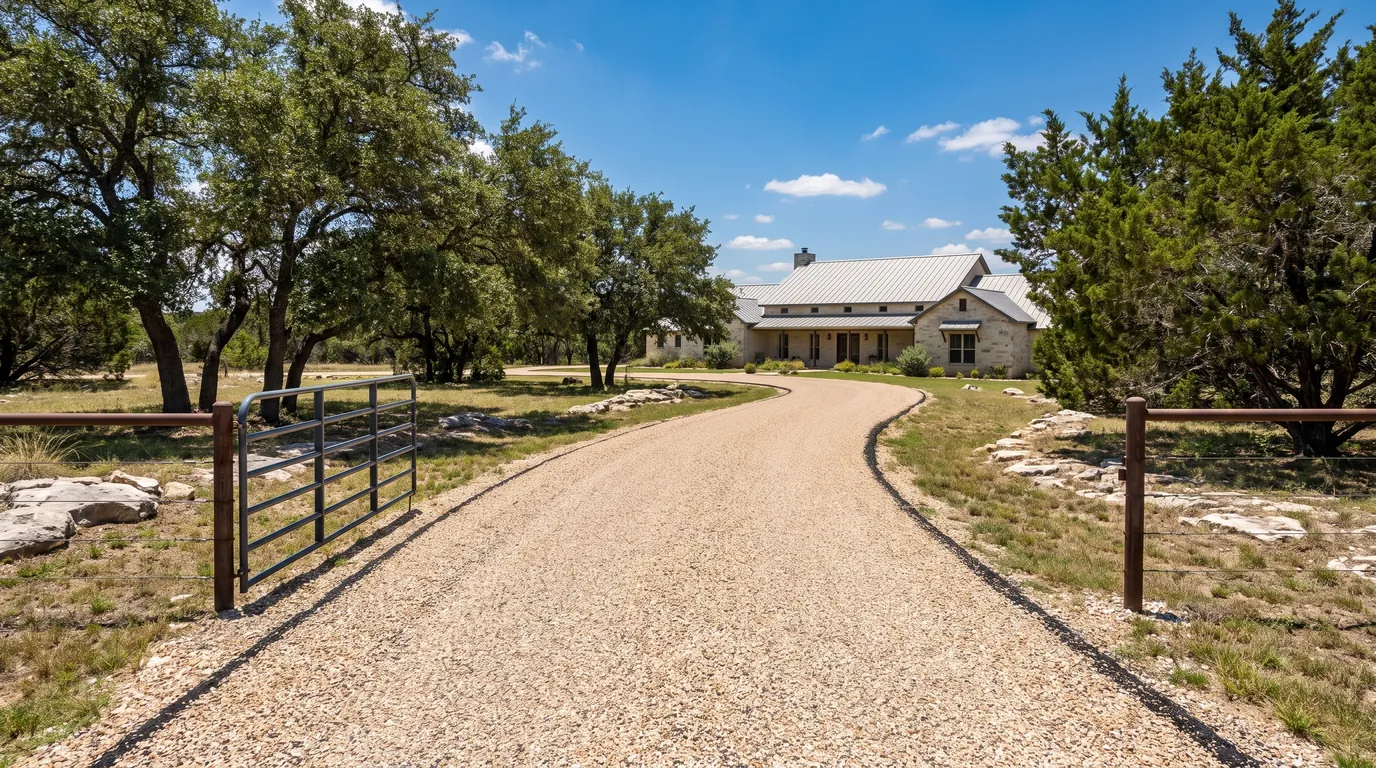
A lot of rural roads in Texas are chip sealed, and the same surface works on a driveway. It looks like packed gravel, and it holds together because asphalt glues the stone down. We build chip seal driveways on ranch and acreage property around Austin.
How we build a chip seal driveway
We grade the drive and build a compacted base, the same way we would for asphalt. Then we spray hot liquid asphalt binder across the base.
We spread a layer of stone chips right away and roll them in. For a tougher surface, we add a second layer of binder and stone, called a double chip seal. After it sets, we sweep off the loose stone.
Where chip seal fits
Chip seal works well on long drives to a house or barn, ranch roads, and in country settings where a black driveway would look out of place. It gives you more grip than smooth asphalt and holds up to farm trucks. It’s rougher to walk or roll a cart on, loose stones are common for the first weeks, and the surface isn’t suited to skateboards or kids’ bikes. Straight runs suit it better than tight turnarounds because turning tires can scuff the chips loose.
Upkeep
During the first few weeks, loose stone works free, so we sweep it off and you can rake or sweep stray chips back onto the driveway. Avoid sharp turns in place on hot days early on. We patch bare spots with binder and stone. When the surface wears thin, we put a fresh chip seal layer over the old one.
What chip seal costs
HomeGuide’s tar and chip cost guide, dated December 2025, puts chip seal at $2 to $5 per square foot, with $2 to $3 per square foot for a single layer and $3 to $5 per square foot for a double layer. You can find other published figures in the cost guide.