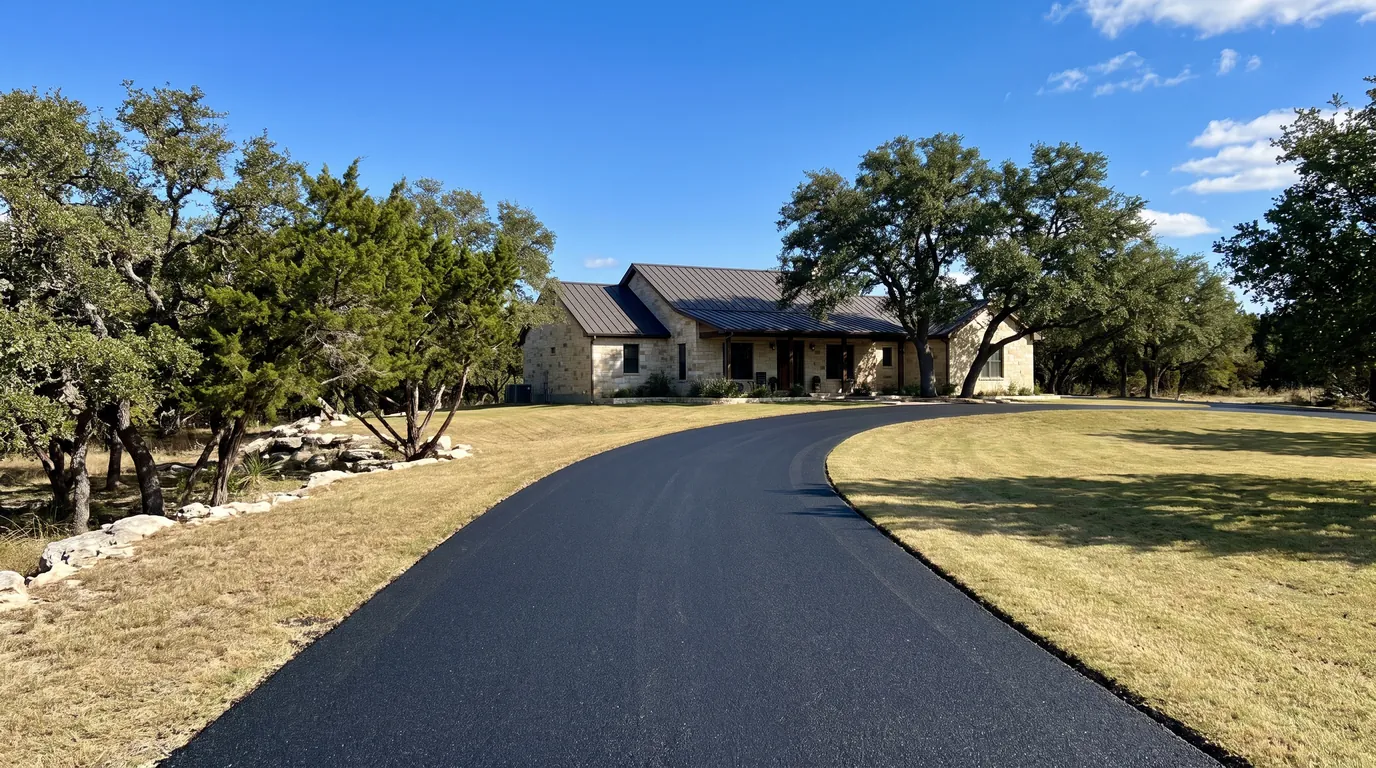
At National Asphalt Paving, we pave driveways across Austin and Central Texas, from a short drive in a subdivision to a long run back to a house on acreage. Most of the work happens before any asphalt shows up because the ground has to drain and the base has to be solid. A driveway built on a weak base will crack and sink no matter how good the asphalt on top is.
What goes into a new driveway
We strip away grass, topsoil, or the old surface until we reach firm ground. Then we grade the driveway so water runs off it and away from the house and garage. We lay crushed base rock and compact it in layers, digging out and rebuilding soft spots before we pave.
On most drives, we lay hot-mix asphalt with a paver and use rakes by hand where the machine can’t reach. We roll the asphalt while it’s hot so it compacts tight, then compact and shape the edges so they don’t crumble. Driveways that carry trucks, trailers, or an RV get a thicker base and more asphalt, so tell us what drives on yours.
Driveways we pave
We pave straight drives, curved drives, circle drives, turnarounds, and parking pads beside the garage. We can widen an existing driveway or pave a long gravel ranch drive partway or all the way to the house. Where a driveway meets the street inside city limits, the apron is right-of-way work. In Austin, the apron is a concrete approach built under a city permit, and we pave up to it.
Before we start
Know where your property lines are, and mark sprinkler heads and lines along with any buried wires to a gate or shop. If you’re in an HOA, get its approval before we schedule.
A new apron at the street inside Austin city limits needs a city permit, and new paved area counts toward the lot’s impervious cover limit, which caps how much of the lot can be covered by surfaces water can’t soak through. We call 811 for a utility locate before we dig. Read about both in permits and Austin rules in our cost guide.
The first weeks on new asphalt
New asphalt stays soft for weeks, and it stays soft longer in summer heat. In the first weeks, avoid turning the steering wheel while the car is stopped, parking in the same spot every day, kickstands, trailer jacks, and heavy trucks. We’ll tell you when you can drive on it. The first sealcoating waits until the asphalt has cured.
What a new driveway costs
Angi’s Austin driveway cost page, updated March 2026, puts asphalt driveways at an average of $4.50 to about $8 per square foot. For other published ranges and what moves the price, see our asphalt driveway cost guide.